
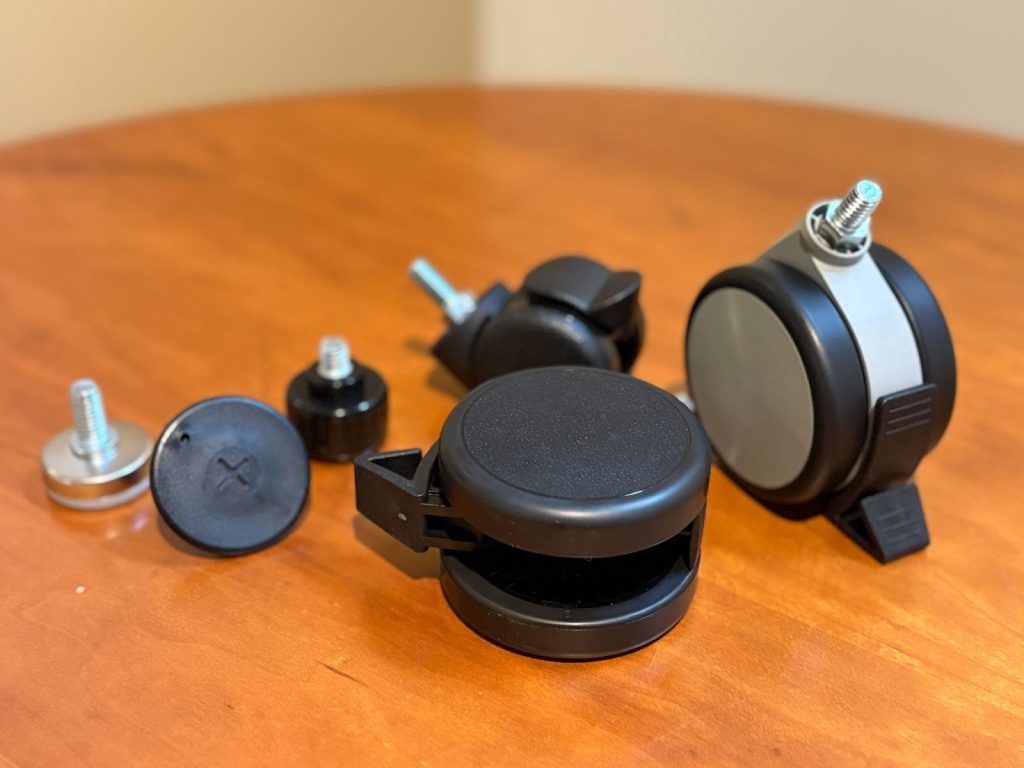
Executive Summary
For commercial furniture, only a few decisions prove to be as underrated as choosing between table levelers and casters. This choice affects everything from daily user experience to long-term maintenance costs.
Gibraltar has been manufacturing table bases and components for over two decades, and we consistently see how making the right choice between levelers and casters makes the difference between furniture that performs flawlessly for years and furniture that becomes a source of ongoing frustration.
What This Guide Covers: The essential differences between levelers and casters, how to evaluate your specific requirements, and a clear framework for making confident hardware recommendations. By the end, you’ll understand not just which solution to recommend, but why – and how to explain that reasoning to your customers.
Five Fundamental Assessment Questions:
- How often will your tables need to be moved or reconfigured?
- What are your load requirements, including equipment and materials?
- What type of flooring needs protection in your space?
- Is maximum stability essential for your application?
- What are your staff’s operational capabilities?
Why This Choice Matters So Much
The Stability vs. Mobility Trade-off
Every table hardware decision involves a fundamental engineering trade-off between stability and mobility. Physics won’t let you optimize for both simultaneously – adding wheels inherently compromises absolute stability, while stationary levelers sacrifice reconfiguration flexibility.
Understanding this trade-off explains why “good enough” or hybrid solutions often disappoint. That conference table that wobbles during presentations because it’s on casters? Someone chose casters when the application demanded levelers. Or that training room where setup takes three times longer than planned because tables have to be carried into place? These results can happen without having put enough thought into how the space will be used.
The question isn’t which solution is “better” in absolute terms. Rather, it’s which trade-offs align with your customer’s operational priorities.
The Real Costs of Wrong Hardware Decisions
In our decades working with furniture manufacturers and dealers across diverse markets, we’ve seen how hardware selection impacts everything from daily operations to long-term costs.
Setup inefficiency compounds in reconfigurable environments. Time spent wrestling with furniture translates directly to labor costs. The difference between 10-second setup and 60-second manipulation adds up more than most people might realize when staff reconfigure spaces daily.
Replacement costs hit sooner than expected. Most commercial floors aren’t perfectly flat and can be off by more than 1/4 inch across a table’s length. Budget-grade hardware typically doesn’t compensate for these irregularities under repeated loading cycles. Floors can also be damaged when users drag tables with levelers into place (instead of just being able to roll the table around if it had casters).
After fielding hundreds of hardware selection questions from OEMs and dealers, we recognized that most specification mistakes don’t come from a lack of information but from unclear decision frameworks. This guide gives you a systematic approach to hardware selection that you can apply confidently across diverse client situations.
Understanding Your Options
Before comparing performance characteristics, let’s establish what these hardware solutions actually are and how they fundamentally work.
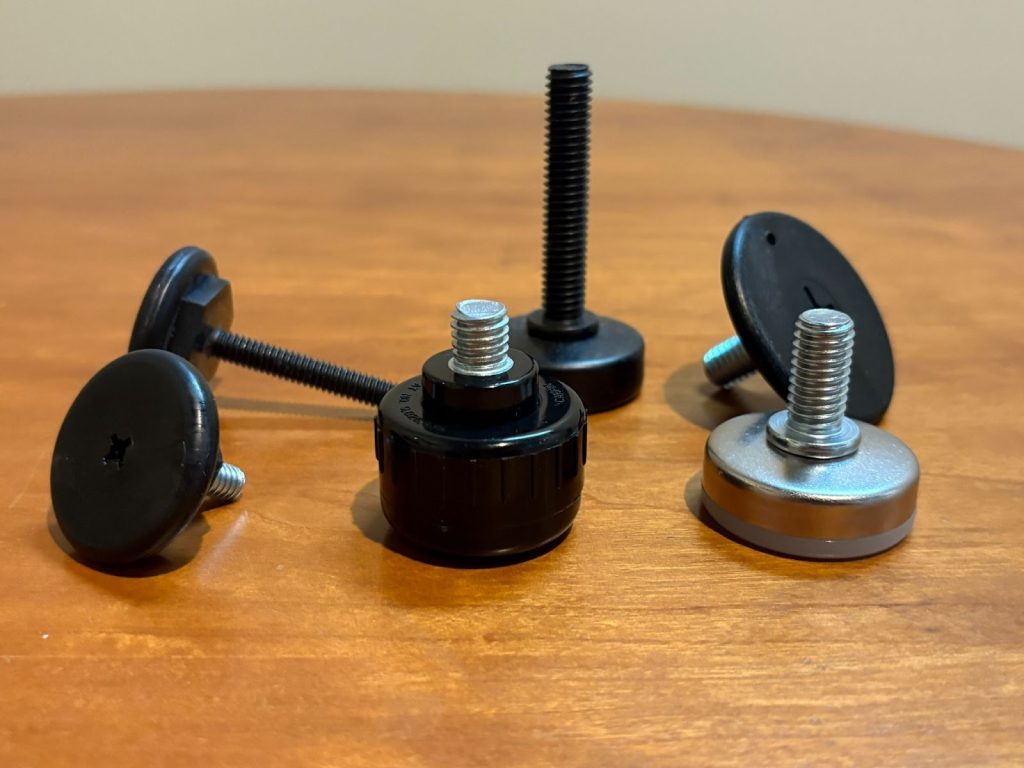
Levelers: The Stability Solution
Levelers are stationary components designed to compensate for floor irregularities and provide rock-solid stability. The core mechanism is simple – adjustable height at each support point allows you to compensate for uneven floors and create a perfectly stable surface.
Adjustable levelers use thread-based mechanisms to provide precise height control. By rotating the threaded component, you raise or lower individual contact points until the table sits level and stable. Quality designs feature fine-pitch threads that resist backing out under load.
Fixed glides provide non-adjustable contact through carefully selected materials, working well when floors are reliably flat or when permanence matters more than adjustability.
Self-leveling glides offer automatic adjustment through internal springs or mechanical linkages, distributing loads across contact points without manual intervention.
The unifying characteristic is that levelers keep tables stationary. Once positioned and adjusted, they provide a well-grounded table.
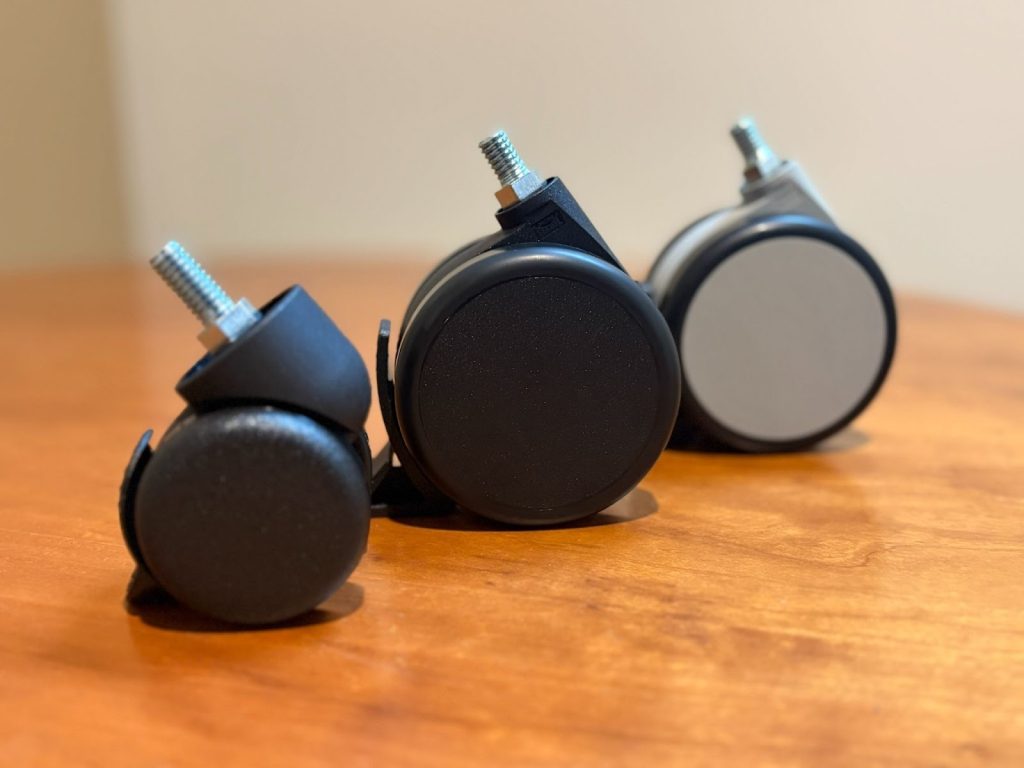
Casters: The Mobility Solution
Casters are wheeled components that enable table movement, engineered for spaces requiring frequent reconfiguration or furniture repositioning. Wheels mounted on swiveling or fixed brackets enable tables to roll across floors.
Locking casters feature braking mechanisms that restrict movement when engaged, providing secure positioning during use while enabling easy repositioning when unlocked. Quality locking mechanisms engage reliably and maintain hold under dynamic loads.
Non-locking casters provide continuous free-rolling mobility for applications where tables need constant repositioning.
Wheel material selection dramatically affects performance. Casters with soft materials typically are superior for hard floors, whereas hard casters can function better on soft & carpeted floors. Soft casters will have increased traction and provide better grip on a hard floor, and can help to protect sensitive flooring. Hard casters will be more effective on carpet and typically have higher durability.
Caster size is also a potential factor when choosing the right solution. While the size of the caster can play a part visually, it may also actually affect how a table rolls over a transition in the floor, such as going from carpet to concrete (or vice versa). Large casters roll more effectively over flooring transitions compared to smaller casters.
The unifying characteristic here is that casters prioritize mobility. Even when locked, they can’t achieve the absolute stability of levelers, but that trade-off makes perfect sense for applications requiring frequent reconfiguration.
When to Choose Levelers
Best-fit applications for levelers include:
- Permanent or semi-permanent installations where tables remain positioned for weeks or months
- Premium stability requirements in executive conference rooms or presentation areas
- Heavy-load applications requiring optimal support
- Applications where absolute stability matters more than reconfiguration ease
When to Choose Casters
Best-fit applications for casters include:
- Reconfigurable spaces requiring frequent furniture movement
- Multi-purpose facilities with varied layouts
- Environments where single-person operation is essential
- Applications where setup speed is critical
- Installations requiring regular cleaning and maintenance access
Key Decision Factors
The difference between hardware that delights your clients and hardware that disappoints often comes down to asking the right questions before specification. We’ve developed this framework based on years of helping OEMs and dealers navigate these decisions across thousands of installations.
Five Critical Assessment Questions
1. How often will tables need to be moved or reconfigured?
Daily or weekly movement strongly favors casters because the time savings compound quickly when staff reconfigure spaces regularly. Monthly or less frequent changes shift the calculus toward levelers, since the occasional inconvenience of lifting and readjusting is acceptable for the superior stability you get the other 364 days per year. Permanent installations typically favor levelers: why compromise stability for mobility they’ll rarely use?
2. What are the load requirements?
Standard conference use (laptops, monitors, documentation) usually involves no more than 150-200 pounds of distributed load that both solutions handle comfortably. Heavy equipment applications exceeding 300-400 pounds often favor levelers for their higher capacity ratings. Remember to account for dynamic loading—people leaning, equipment vibrating—and specify with 30-40% safety factors above calculated static loads.
3. What type of flooring needs protection?
You may want to make your choice based on floor protection first, then optimize for other characteristics. Tile and stone can require attention to grout protection in larger contact areas. Carpet considerations depend on pile depth, with deeper carpet sometimes making casters impractical. If casters are needed, then choose soft casters for hard floors and hard casters for carpet. Also, choose larger casters for thicker carpet or when rolling tables over threshold crossings on the floor.
4. Is maximum stability essential?
Precision work, premium presentation environments, and equipment support applications require the kind of stability only levelers provide. General commercial use typically works fine with quality locked casters – the slight compromise in absolute stability is operationally irrelevant for most users. This comes down to considering the potential consequences. If minor wobble creates genuine operational problems or professional image concerns, choose levelers.
5. What are the staff’s operational capabilities?
Single-person operation requirements clearly favor casters. Varied staff capabilities in educational institutions or community centers benefit from caster simplicity, where the learning curve is basically zero. Dedicated facilities teams can handle either solution efficiently. Consider physical requirements, such as how moving leveler-equipped tables takes lifting strength, while rolling caster-equipped tables need pretty much minimal exertion.
Decision Framework
Choose levelers when:
- Maximum stability is non-negotiable
- Tables remain positioned for extended periods
- Floor protection for premium surfaces is critical
- Load requirements are heavy or involve precision equipment
Choose casters when:
- Reconfiguration frequency is high
- Single-person operation is essential
- Setup speed directly impacts operational efficiency
- Space flexibility demands mobile furniture
- Adequate stability meets application requirements
When priorities conflict: Determine which matters more frequently. If your customer reconfigures sporadically but uses the space in a stable configuration 90% of the time, consider whether the convenience of casters during only 10% of use really justifies choosing them over levelers.
Common Implementation Mistakes to Avoid
When leveler-equipped tables aren’t properly leveled during installation, users assume the table is defective rather than recognizing that adjustment is needed. Take the time to level tables properly during installation to prevent years of (mistakenly) perceived quality problems.
Caster locks seem obvious, but users in busy environments often don’t engage them properly. Clear instructions prevent frustration from tables that “won’t stay in place” because users don’t understand the locking mechanism. Keeping casters fully seated and not adjusting them is important to ensure the casters perform as intended.
Just because hardware can support specified loads doesn’t mean concentrated loads at table edges won’t create problems. Ensure furniture design distributes loads appropriately across hardware contact points.
Why Choosing Gibraltar Makes a Difference
After more than twenty-five years of manufacturing table bases and components in our Michigan facility, we’ve developed a philosophy that goes beyond meeting minimum specifications. We analyze how hardware actually performs in commercial use, then design solutions that reflect actual realities.
The Reliability That Protects Your Reputation
When you specify Gibraltar hardware, you’re making a decision you can stand behind with confidence. Our 99.9% on-time, error-free shipping record means your projects proceed on schedule. And our commitment to quality means hardware performs as expected throughout its service life.
Performance longevity justifies your investment. Budget hardware seems economical until you calculate replacement costs, labor for removal and reinstallation, operational disruption, and client dissatisfaction. But our products are known for commercial durability, and the total value of ownership—accounting for extended service life and reliable performance—makes a huge difference for you and your customers.
Partnership Support
Our technical team provides genuine consultation. We listen to understand your application requirements, share operational considerations, and recommend solutions based on decades of manufacturing experience. Next-business-day response times mean your questions get answered promptly. You’ll work directly with our Michigan team that manufactures the products you’re specifying – no automated phone systems or overseas support centers.
For large or complex installations, we provide project-specific consultation to work through application variations, load requirements, and operational considerations that ensure optimal hardware selection across diverse space types.
When to Consult Gibraltar’s Team
This isn’t an exhaustive list, but here are some situations where you might want to connect with us:
- Large or complex projects with diverse space types
- Unique or demanding applications outside typical commercial patterns
- Custom solution development for projects where standard products don’t quite meet requirements
- Performance troubleshooting when existing hardware isn’t performing as expected (and you need better options)
- Floor protection questions for premium or specialty flooring (where specification mistakes create expensive consequences)
We’re here to support your decisions with industry expertise, manufacturing quality, and collaborative consultation. Whether you’re working on a single conference room or furnishing an entire campus, our team is ready to help you make hardware choices that serve your customers well for years to come.
Conclusion
The choice between table levelers and casters might seem like a minor detail, but hardware selection fundamentally shapes how furniture performs throughout its service life.
Get the decision right (matching characteristics to operational requirements, load demands, floor conditions, and user capabilities) and your customers benefit from years of reliable, frustration-free performance.
Get it wrong (prioritizing mobility when stability matters more, or vice versa) and you create ongoing frustration that colors your customers’ entire perception of the furniture investment.
The good news is that you don’t have to do it alone. If you ever have any questions, we’re here for you. Feel free to reach out and we can work together to find the best solution.
Your Next Steps
For immediate project needs:
- Apply the five critical assessment questions to your current project
- Use the decision framework to determine whether levelers or casters better match requirements
- Review the application-specific guidance for your project’s space types
- Contact our team with specific questions or for project consultation
Contact Gibraltar
Phone: 616-748-4857
Email: [email protected]
Website: gibraltarinc.com