
The right product finish and color brings a room together – it stands out, accentuates the room, but fits in seamlessly at the same time. The wrong finish draws the wrong attention, degrades the structural design, and even creates a poor user experience with the wrong texture for the wrong environment.
We put this guide together to help you make confident finish decisions on every project. We’ll walk through how powder coating works, how to read gloss levels, and how to pair table base finishes with tabletops and their surrounding environments. By the end, you’ll have a practical framework you can bring into any client conversation.
Why Finishes Deserve More Consideration
A table base can be precisely engineered, structurally sound, and beautifully designed, and the wrong finish will still undermine it. Not dramatically, but in the way that makes a client feel like something is slightly off without being able to name it. A warm wood tabletop paired with a cool-toned silver base. A sleek modern conference room interrupted by a wrinkle-textured finish that reads as industrial. These aren’t catastrophic misses, but they erode confidence in the product and in the people who specified it.
Finish decisions also have consequences beyond the initial installation. A finish that isn’t suited for a high-traffic environment will show wear faster than expected, and when that happens, it becomes your problem as much as the client’s.
On the other side, when a base finish coordinates naturally with the tabletop and the space feels cohesive, clients notice. It shows up in how they talk about the product to colleagues and whether they come back for the next project.
Understanding Powder Coating
Powder coating is the finishing standard for commercial table bases, and it’s worth understanding why.
The process involves applying a dry powder electrostatically to a metal surface, then curing it under heat. The result is a durable, uniform finish that bonds directly to the metal rather than sitting on top of it like a coat of paint. Compared to liquid paint alternatives, it resists chipping, scratching, and fading far better under commercial conditions. It also delivers color consistency that matters when producing large orders or reordering over time. In other words, the finish on a base made this year should look the same as one made ten years from now.
For OEMs and dealers, that translates to fewer product-related issues in the field. A quality powder coat finish, properly applied, simply doesn’t generate the callbacks and complaints that inferior finishes do.
Making Sense of Gloss Levels
Gloss level is one of the more misunderstood variables in finish selection. Most people know intuitively that some finishes look shinier than others, but fewer think about gloss as a deliberate design and performance choice. It is both.
Gloss is measured numerically, running from very low (in the low teens) to very high (in the mid-to-upper nineties). The higher the number, the more light the surface reflects.
- Lower gloss finishes—roughly 12 to 30—read as understated and professional. They absorb light rather than reflecting it and are more forgiving of everyday contact marks and minor surface wear. For most commercial environments, this range is a safe and versatile choice.
- Mid-range finishes, from around 37 to 70, offer more visual presence without the boldness of high gloss. Champagne and silver tend to land here—they suggest quality and refinement without demanding attention.
- High gloss finishes, from roughly 71 to 90+, are the most visually striking and well-suited for environments where the furniture is meant to make a statement. The tradeoff is that they show fingerprints and contact marks more easily.
Lighting conditions also affect gloss perception more than most people expect. A finish that looks polished under warm showroom lighting can feel cold under fluorescent office lights. That’s not a flaw in the finish. It’s just physics.
And that means evaluating a finish from a digital image is genuinely unreliable. The only way to know how a finish will read in a specific environment is to evaluate a physical sample under that environment’s actual lighting.
Visit our Finishes page to learn more and request a free physical sample ring.
Matching Finishes to Tabletops and Environments
Once you understand gloss and have a sense of the environment, the question becomes how the base finish relates to everything around it, primarily the tabletop, but also the broader space.
There are two fundamental approaches:
- Coordination—where the base finish is close in tone and temperature to the tabletop—creating a unified, cohesive look.
- Contrast—where the base and tabletop are intentionally different—adds visual interest and design intention.
Neither is inherently better.
With wood and wood-tone laminates, warm neutrals, bronze tones, and blacks tend to complement the natural warmth of the surface. High-gloss metallics can feel disconnected from wood textures. Light solid surfaces and white laminates are versatile — a dark base creates clean contrast, while a soft white or champagne finish creates a quieter, more unified look.
Dark tabletops open up more options; lighter bases can balance visual weight, while matching dark tones work well in more dramatic spaces.
In corporate settings, neutrals at lower gloss levels support the space without competing with it. Hospitality environments offer more latitude for warmer metallics and bolder colors. And where clients have defined brand identities—school colors, corporate palettes—finish becomes a direct expression of that identity, which is where more-vibrant colors come into play.
Durability and Maintenance by Finish Type
Not all environments put the same demands on a finish, and matching selection to actual use conditions is part of specifying well.
High-traffic settings put more physical stress on a base finish than a private office or low-volume conference room. Lower gloss levels are generally more forgiving, since small contact marks don’t catch light the way they would on a higher-gloss surface. Textured finishes like Black Wrinkle can conceal surface wear effectively, though they require more attention when cleaning.
Where surfaces get wiped down frequently or cleaned with commercial agents, smooth finishes are the more practical choice. They’re easier to clean thoroughly, and that matters when durability and hygiene carry equal weight.
High gloss finishes are more visually striking, but they show fingerprints and contact marks more readily. That’s not a quality issue — it’s simply how reflective surfaces behave. A brief conversation about this at the specification stage prevents a lot of unnecessary friction down the road.
A Decision Framework for Finish Selection
These five questions work on virtually any project:
- What is the primary environment, and how demanding is the use case? Traffic level, use intensity, and cleaning frequency all shape which finishes are appropriate.
- What is the tabletop material, color, and texture? The base finish doesn’t exist in isolation, and understanding what it’s paired with is the starting point for coordination or contrast decisions.
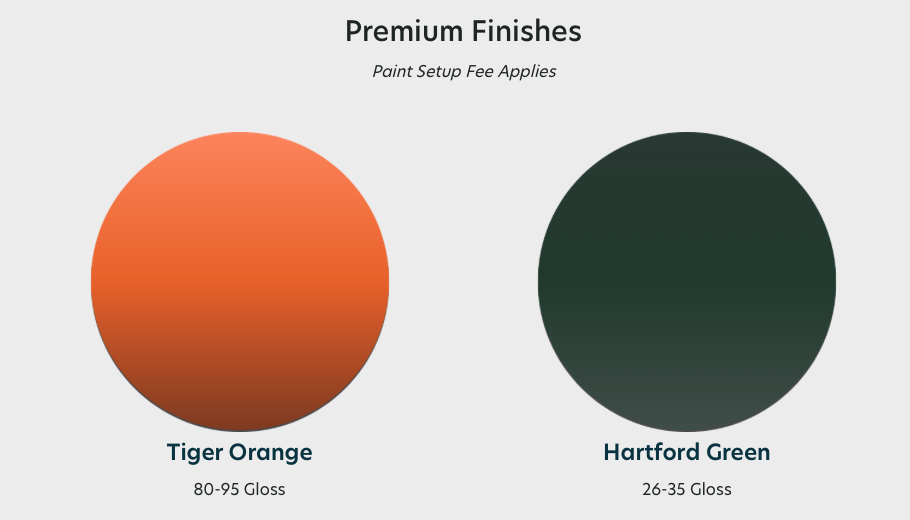
- Does your client have defined brand colors or a specific aesthetic direction? If yes, the premium finish conversation is worth having early. If no, the standard range is likely where the project lands.
- What are the cleanability and durability requirements? High-demand environments favor smooth finishes and lower gloss levels. Lower-demand settings open up more options.
- What is the budget structure? Standard finishes avoid setup fees. Premium finishes add cost that needs to be accounted for. Neither is inherently the right answer. It just depends on what the project calls for.
When the answers point in a clear direction, the finish selection becomes straightforward. When they conflict (like a high-traffic environment paired with a client who wants a bold premium color), the framework helps surface the tradeoffs before the order is placed rather than after.
One final note on the process:
Physical samples make a real difference in these conversations. Evaluating a finish on a screen is a starting point, not a final step. Gibraltar’s finish sample ring is available at no cost to qualified furniture dealers, manufacturers, and design professionals, and it’s worth having on hand before finish conversations begin rather than after.
Working With Gibraltar on Finish Selection
Gibraltar’s finish range of standard and premium colors was developed with the real-world needs of OEMs and dealers in mind. Our standard tier covers the core of what most commercial projects require. And our premium tier gives you the flexibility to serve clients with specific brand requirements, distinctive design visions, or a need to stand apart in competitive markets.
When finish questions get complicated, whether that’s a custom color request, an unusual environment, or a project where you’re not sure which direction to go, our team is here to help. We’ve spent over 25 years manufacturing table bases and components, and finish consultation is part of the partnership we offer, not a separate service.
If you’d like to request a finish sample ring, explore our full finish range, or talk through a specific project, reach out to our team. We’re happy to help you get it right the first time.