
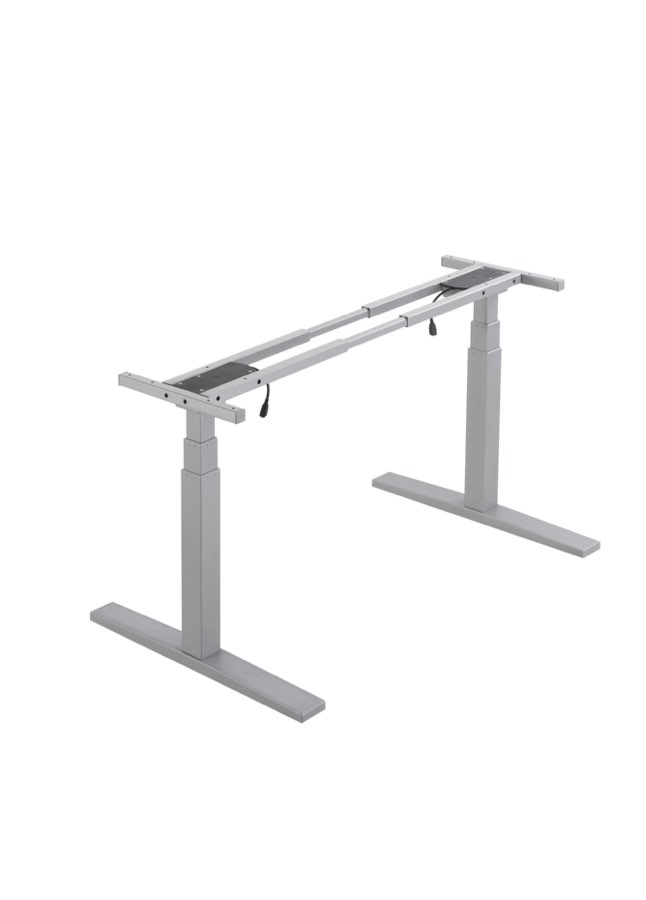
When your customers choose furniture for their spaces, adjustable table height might seem like a minor detail. But height adjustment plays a bigger role in how people work, learn, and interact in our environments than most of us realize.
Choosing the right adjustment mechanism can make a space dramatically more functional. This avoids investing in furniture that either sits unused or frustrates everyone who has to use it.
We want you to be confident that you’re making decisions that serve your customers well for years to come. To help you do that, we’ve created this guide on adjustable-height tables. In it, we walk through the various adjustment mechanisms, how they work, and which are best for various use cases. And if you ever want more personalized recommendations, feel free to reach out.
Why Table Height Adjustability Matters
Not every table needs to be adjustable. Fixed-height tables work perfectly fine in countless applications. But when you need adjustability, it becomes one of the most important features you can provide.
Think about a shared workspace where employees might range from 5’2″ to 6’4″. That standard 29-inch desk height? It’s uncomfortable for both extremes. Over weeks and months of repeated use, small discomfort becomes a genuine health concern.
Or consider a training room that hosts both adult workshops and youth programs. Fixed tables force compromise that affects comfort and engagement.
Height adjustability solves these types of problems directly.
Multi-user environments benefit most obviously. Hot-desking arrangements, co-working spaces, library study areas, and training facilities all serve diverse populations throughout the day.
Accessibility requirements often drive adjustability decisions. ADA compliance requires wheelchair users to have tables with proper knee clearance.
Sit-stand workstations have moved beyond trendy wellness initiatives. Alternating between sitting and standing throughout the day reduces employee fatigue and increases focus.
Choosing the wrong adjustment mechanism creates problems that compound over time. Tables that are difficult to adjust simply don’t get adjusted. Mechanisms that fail under commercial use create maintenance headaches.
Knowing the options and matching them to your customer’s actual needs prevents these outcomes entirely.
Understanding Adjustment Mechanisms
Three primary mechanisms dominate the adjustable table market. Each serves different needs, and understanding how they work helps you determine what will work best for your project.
Spring-Clip Adjustable Systems
Spring-clip systems use a spring-loaded pin that locks into preset holes at different heights. Release the pin, move the table to the desired height, and let the pin snap back into the nearest hole. The entire process takes about five seconds.
Most spring-clip systems offer height positions spaced in 1” increments, typically adjusting across a 12-18 inch range. Common ranges run from about 22 inches (seated wheelchair height) up to 36-40 inches (standing work height).
Maintenance requirements are minimal. These systems have few moving parts, nothing that requires regular service, and operate quietly with just a small click when the pin locks into position.
Hand-Crank Adjustable Systems
Hand-crank systems use a mechanical gear mechanism to raise and lower tables smoothly through a continuous range of heights. Turn the crank handle, and the table moves up or down at a controlled pace.
These adjustment systems allow for infinite positioning (within their adjustment range). The mechanical advantage means tables carrying substantial loads can be adjusted without excessive physical effort. The trade-off is speed, as adjusting through the full range takes 30-60 seconds. Hand-crank systems typically offer wider adjustment ranges and higher load capacity than other mechanisms. Ours features a height range of 26.5”-39.75” and a load capacity of 200 lbs.
Hand-crank systems typically cost more than spring-clip mechanisms but less than electric ones.
When Hand-Crank Systems Excel
Industrial and workshop environments get the most value from hand-crank adjustability. The robust construction and high load capacity support heavy tools, equipment, or assemblies. Laboratory benches benefit from precise positioning for microscope work or specialized procedures. When tables are adjusted infrequently but need to stay at specific heights for extended periods, hand-crank mechanisms work well.
Electric Adjustable Systems
Electric systems use motors to raise and lower tables at the push of a button. Some include programmable memory positions that recall specific heights for different users or tasks. The motor does all the work, making adjustments practically effortless.
Most electric systems move at about 1-2 inches per second, meaning a full-range adjustment takes 15-30 seconds. The electric base we offer has a range of 23.25”-49.25” and a max load of 260 pounds.
Practical Considerations for Electric Options
Power requirements add complexity and cost. Every table needs access to electrical outlets, which affects furniture layout flexibility. Cable management can be a concern. The initial purchase price is higher than mechanical alternatives.
When Electric Systems Excel
Individual workstations where users frequently transition between sitting and standing benefit enormously from electric adjustment. When someone switches positions multiple times daily, the efficiency justifies the investment.
Executive offices, professional environments, and premium spaces often choose electric systems for a polished user experience. Environments prioritizing accessibility also find that electric systems support users who might struggle with manual adjustment methods.
Comparing Height Adjustable Table Options at a Glance
| Spring-Clip | Hand-Crank | Electric | |
| Adjustment Speed | 30-45 seconds | 30-60 seconds | 15-30 seconds |
| Ease of Use | Modest physical effort | Sustained physical effort (hardest) | Minimal physical effort (easiest) |
| Power Requirements | No power infrastructure needed | No power infrastructure needed | Requires an electrical outlet for every table |
| Maintenance | Minimal | Moderate | Occasional (servicing electronic components) |
| Cost | Most economical | Mid-range pricing | Premium pricing |
Selection Framework: Six Essential Questions
Making confident decisions becomes straightforward when you go through these assessment questions systematically.
Question 1: How Often Will Height Actually Change?
When users genuinely adjust tables several times per day, electric systems make sense despite higher costs. And spring-clip systems are ideal for those who don’t need to adjust height constantly.
If adjustments happen once or a few times per day (shift changes, different classes), spring-clip systems hit the sweet spot. They’re fast enough to be convenient, simple enough that anyone can operate them, and economical enough to furnish multiple locations.
For tables adjusted infrequently (monthly reconfigurations, occasional accommodation), almost any mechanism works. Hand-crank systems work well if your customers need high load capacity or precise positioning.
Question 2: Who Will Be Adjusting the Tables?
Individual workstations serving one primary user can support more sophisticated adjustment systems. Shared environments serving diverse populations need mechanisms that anyone can operate immediately with minimal instruction. Spring-clip systems are typically better operated with two (or more) people.
When trained facilities staff handle adjustments rather than end users, more complex mechanisms become acceptable. However, empowering end users to adjust tables themselves often leads to better outcomes.
Question 3: What Are the Total Load Requirements for the Tables?
Start with the tabletop weight, then add equipment and materials. Office equipment (computers, monitors, etc.) might total in the range of 45-100 pounds, educational settings 20-40 pounds (not counting the tabletop), and industrial equipment up to a total of 200-400+ pounds.
Add 30-50% to account for dynamic forces like users leaning on height-adjustable tables, then build in a safety net by doubling the calculated load requirement.
Standard office and educational loads work fine with any mechanism. Heavier applications favor hand-crank systems. Very heavy applications may require specialized hand-crank systems.
Question 4: What Are the Height Range Requirements?
Typical seated desk work happens at 26-30 inches. Adjustable tables serving seated workers should ideally range from 24-25 inches (shorter users, wheelchair accessibility) up to 32-34 inches (taller users). If the same table needs to support standing work, extend the upper range to 40-44 inches.
Spaces serving children through adults should have extensive adjustable height ranges, as elementary students might need 20-22 inches, while adult education requires 34+ inches.
Spring-clip systems typically space positions 1-2 inches apart, which works perfectly fine for most applications. If users genuinely need positioning at very specific heights, the continuous adjustment of hand-crank or electric systems might be worth the additional complexity.
Question 5: Is Power Readily Available?
Electric systems need power for every table location. Newer commercial buildings often include abundant floor outlets, but older buildings may have limited outlet locations, and retrofitting power adds substantial cost and disruption.
Spaces that reconfigure regularly benefit from furniture that doesn’t depend on specific power locations. Spring-clip and hand-crank tables can go anywhere without worrying about extension cord routes or outlet access.
A realistic cost comparison might include electrical work in the total project budget. Mechanical mechanisms could potentially deliver adjustability at half the total installed cost in spaces that need electrical upgrades.
Question 6: What Are the Budget Considerations?
Spring-clip mechanisms for adjustable table heights usually cost the least per unit. When furnishing multiple workstations or major projects, the cost advantage compounds significantly. Hand-crank systems fall in the middle range. Electric systems command premium prices, sometimes 2-3 times the cost of spring-clip alternatives.
Maintenance differs substantially. Spring-clip systems typically require minimal ongoing maintenance. Hand-crank systems need periodic lubrication. Electric systems involve components that eventually require service.
Quick Application Guidelines
Understanding how different environments benefit from specific mechanisms helps clarify your decision for adjustable-height tables.
| Corporate Hot-Desking and Shared Workstations | Spring-clip systems provide the speed and simplicity needed when multiple employees use the same desk throughout the day. |
| Training Rooms and Educational Facilities | Spring-clip mechanisms let facilities staff reset room configurations in minutes between sessions. They are also ideal for classrooms where different age ranges need to use the same space periodically. |
| Individual Sit-Stand Workstations | Electric systems justify their premium cost when employees adjust frequently throughout each day. |
| Laboratory and Research Environments | Hand-crank systems provide the precise positioning researchers need for microscope work and specialized procedures. |
| Industrial Work Surfaces | Hand-crank mechanisms deliver the load capacity and structural robustness that manufacturing environments require. |
| Co-Working Spaces | Spring-clip adjustability allows operators to provide height adjustment throughout their space rather than only at premium workstations. |
| Accessibility-Priority Environments | Electric systems remove physical barriers for users with limited mobility or strength. Quality spring-clip systems with smooth operation can also serve accessibility needs while remaining more economical. |
Making the Right Choice
The adjustable-height table decision hinges on matching mechanism capabilities to specific operational needs.
Choose Spring-Clip Systems When:
Your customers need fast, simple adjustability for multiple users. Training rooms, shared workspaces, educational facilities, co-working spaces, and library environments all typically benefit from spring-clip mechanisms.
Choose Hand-Crank Systems When:
Your customers need support for heavy loads, precise positioning at any height, or have specialized applications like workbenches, laboratories, and industrial environments.
Choose Electric Systems When:
Individual users adjust frequently throughout each day, effortless operation is essential, or a premium user experience aligns with overall space positioning.
What Are Your Next Steps?
Understand your customers’ actual usage patterns. Apply the six-question assessment framework to each application segment you serve that needs adjustable table heights. Choose manufacturing partners with proven commercial-grade quality.
Make sure your customers assess their infrastructure honestly. Power availability, maintenance capabilities, and operational constraints all affect which mechanisms serve your height-adjustable tables and work surfaces best. Consider the total cost of ownership throughout the expected furniture life.
Don’t hesitate to ask manufacturers like us detailed questions about our products. Trustworthy companies will always give you straight answers, technical consultation, and application guidance.
Partnering With Gibraltar
We’re always here to help you find solutions that genuinely fit your needs. Whether you’re furnishing significant spaces, have technical questions, or simply want guidance on mechanism selection for adjustable-height tables, we are happy to give honest consultation based on our decades of manufacturing experience.
Phone: 616-748-4857
Email: [email protected]